

You bought an adult coloring book with the best of intentions. After an exhausting week of workplace deliverables, endless notifications, and mental fatigue, you envisioned spending peaceful evenings with a cup of herbal tea and a set of markers. But when you opened the book to a fresh, crisp white page, an unexpected sensation gripped you: hesitation. Your hand hovered over the paper. You wondered which color to pick first, whether your shading would look professional, and what would happen if your marker slipped outside the boundary. Understanding how to combat perfectionism paralysis in adult coloring is the essential key to transforming a stressful hobby back into a true sanctuary.
For countless adults, the creative urge is hijacked by the inner critic. Instead of offering relief, the blank page becomes another arena for performance anxiety. But creative rest was never meant to be graded. When you learn how to combat perfectionism paralysis in adult coloring, you trade the crushing weight of artistic perfection for the healing freedom of simple, joyful play.
The Irony of Mindful Art: When Relaxation Triggers Performance Anxiety
Modern adult life trains us to optimize everything. From our morning routines to our career trajectories, we are constantly measured by productivity, efficiency, and flawless execution. Without realizing it, we carry this high-stakes mindset into our leisure activities.
When an adult sits down with a complex, hyper-intricate illustration featuring hundreds of microscopic details, the brain's executive functioning system doesn't shut down—it goes into overdrive. You scan the page looking for the "right" palette. You worry that choosing the wrong shade of indigo will ruin hours of work. According to clinical research published by the American Psychological Association on the perfectionism trap, multidimensional perfectionism has risen sharply over the past three decades, leading to increased burnout, anxiety, and self-doubt. In creative pursuits, this manifests as an intense fear of producing something mediocre.
Adult coloring is meant to be a restorative retreat, not an art school exam. If opening your book makes your heart beat faster instead of slower, you are not failing at coloring—your tools and mindset are simply triggering old perfectionist defenses.
Unmasking Perfectionism Paralysis: The Neuroscience of the Blank Page
Perfectionism paralysis in adult coloring is not a lack of creativity; it is a neurological freeze response. When you perceive a blank page as a test you might fail, your amygdala interprets the threat of making an "ugly" piece of art as a threat to your self-esteem.
This triggers three distinct cognitive traps:
- Decision Overload: Staring at a tin of 72 colored pencils paralyzes your working memory. The endless possibilities create cognitive friction before you even lay down your first stroke.
- Catastrophic Comparison: You recall hyper-blended, airbrushed coloring pages seen on social media and assume your work must look identical to be valid.
- The Irreversibility Myth: You fear that an ink smudge or an uneven line permanently ruins the book, triggering regret rather than relaxation.
Recognizing these traps is the first step in overcoming creative freeze. Your coloring book is not a portfolio piece for public display; it is private, disposable scratch paper for your nervous system to untangle itself.
The Shift from Micro-Mandala to Bold & Easy: Why Forgiving Outlines Matter
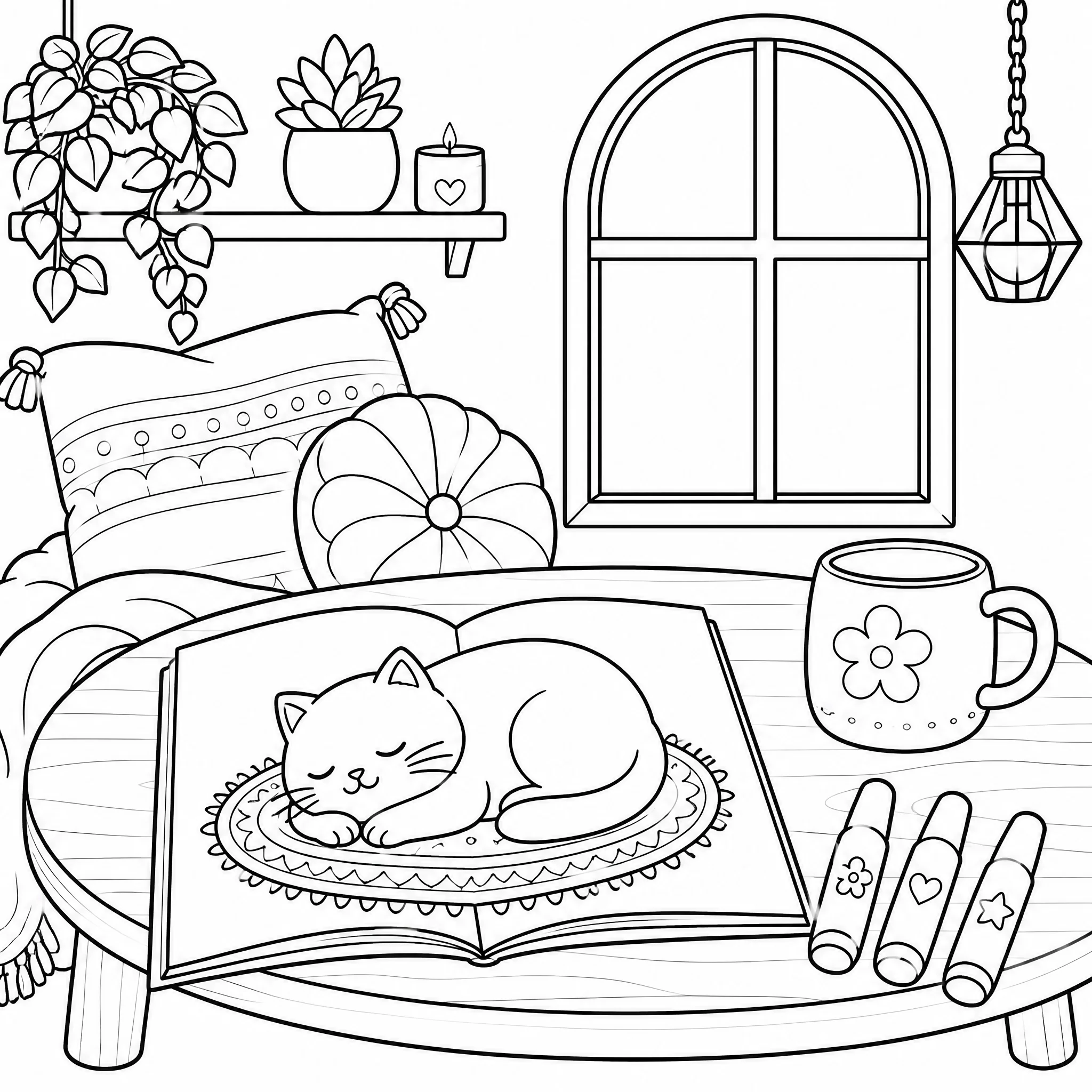
One of the most practical strategies in breaking out of perfectionist paralysis is changing the physical anatomy of the pages you choose. For years, the adult coloring market was dominated by hyper-detailed mandalas and intricate botanical patterns with razor-thin 0.2pt lines. While visually impressive, these designs demand surgeon-like motor control. One slip of the wrist feels glaringly obvious.
This is why the "Bold & Easy" art movement has taken the wellness world by storm. By utilizing ultra-thick 1.2pt to 12pt outlines, generous negative space, and simplified everyday subjects—such as cozy armchairs, warm ceramic mugs, and baking counters—the physical medium itself provides unconditional forgiveness:
- Built-in Buffer Zones: Thick black borders absorb minor marker slips, making bleeding or wandering lines completely invisible.
- Rapid Completion: Because shapes are large and uncluttered, you can complete an entire charming illustration in twenty minutes, delivering a healthy hit of completion dopamine without mental fatigue.
- Gentle Visual Relief: Simple outlines rest tired eyes that spend eight hours a day staring at spreadsheet grids and dense text.
If you want to experience the profound psychological ease of forgiving outlines, our printable collection Simple Pleasures (Printable PDF) was intentionally designed to dismantle performance anxiety. Featuring charming, thick-lined vignettes of quiet morning moments, simple indoor nooks, and unpretentious everyday comforts, it offers a gentle canvas where every stroke feels effortlessly safe.
The 3-Marker Rule: Eliminating Decision Fatigue Before You Begin
Choice paralysis is the quickest route to creative freeze. When you sit down with dozens of color options, your brain exhausts its willpower trying to construct a harmonious color scheme.
To combat perfectionism paralysis in adult coloring with immediate effect, implement the 3-Marker Rule:
- Pick Three Colors Only: Before opening your book, blind-select or deliberately choose just three markers—for example, a warm honey yellow, an earthy terracotta, and a muted sage green.
- Ban All Other Tones: Put the rest of your pencil case completely out of sight.
- Color with Abandon: Fill in every section of the page using only those three tones.
By artificially constraining your choices, decision fatigue evaporates. You no longer have to debate whether a teapot should be cerulean or periwinkle; with only three colors on the table, every choice is quick and obvious. The resulting artwork inevitably looks cohesive, vintage, and stylish precisely because the palette is limited.
The Deliberate Mistake: Breaking the Spell of the Flawless Canvas
The absolute hardest part of coloring for a perfectionist is the first stroke. The pristine, untouched white sheet possesses an intimidating aura of purity.
To instantly break this psychological spell, practice the ritual of the Deliberate First Mistake:
- Open to your chosen page.
- Pick up a dark marker.
- In the outer margin or right inside the corner of a shape, intentionally make an uneven wiggle, a bold squiggle, or let the tip stray past the black line.
- Take a deep breath and look at it.
Notice what happened: the world did not end. The page is no longer pristine, which means the terrifying pressure to keep it perfect has vanished. The spell is broken. Now that the page is already "imperfect," you are free to play, experiment, and color without guarding against an imaginary flaw.
If you are pairing your creative time with an evening screen-free routine to quieten nighttime overthinking, exploring our guide to the Digital Sunset Routine for Adults provides additional tactile frameworks for letting go of daytime control.
Cultivating Tactile Flow: Focusing on Sensation Rather Than the Final Result
Perfectionism thrives when you evaluate art through the lens of a future spectator: *"Will this look good when I finish? What will others think?"* True mindfulness happens when your awareness collapses entirely into the sensory present: *"How does this marker feel against the paper right now?"*
To deepen your ability in how to combat perfectionism paralysis in adult coloring, anchor your awareness into the physical feedback of art-making:
- Listen to the Sound: Tune in to the subtle, satisfying whisper of the marker tip gliding across thick paper. It serves as an organic white noise that anchors wandering thoughts.
- Feel the Pressure: Notice the gentle weight of the pen between your fingers. Release the death-grip tension in your knuckles and drop your shoulders.
- Watch the Color Bloom: Observe the wet ink settle into the fibers of the cardstock. Enjoy the pure, childlike visual pleasure of white space turning into saturated pigment.
When you judge the session by how much physical tension melted from your jaw rather than the aesthetic beauty of the page, perfectionism loses all its power. For structured inspiration on building a consistent, pressure-free daily practice, review our roadmap in The 30-Day Coloring Challenge for Adults.
Frequently Asked Questions
What should I do if I genuinely hate the colors I picked?
Turn the page without guilt. You are under no obligation to finish a page that isn't bringing you peace. Alternatively, grab a dark charcoal or black marker and color right over the section, turning it into a bold silhouette. There are no coloring police.
Does using "easy" coloring books mean I'm not challenging myself?
Adult life supplies more than enough cognitive challenge every single day. Your nervous system does not need your hobbies to be an uphill battle. Bold & Easy coloring is designed for sensory de-escalation, nervous system regulation, and emotional decompression—not technical validation.
What is the best paper to prevent marker bleed-through anxiety?
Anxiety often stems from worrying that alcohol markers will bleed onto the next illustration. Look for single-sided printable books printed on 65lb to 80lb matte cardstock, or slide a spare sheet of heavy watercolor paper or chipboard directly beneath your active page. Eliminating physical bleed-through eliminates another subconscious source of worry.
A Gentle Closing Note: Giving Yourself Permission to Make a Beautiful Mess
We spend our adult lives walking inside tight, invisible lines—meeting expectations, smoothing over conflicts, and striving to get everything right. Coloring is one of the few places left where you are allowed to color outside the lines, pick ridiculous color combinations, and produce something that exists solely for your own private comfort.
Tonight, put away the rules. Pick up one marker. Let your lines be wobbly, let your colors be strange, and give yourself the tender, radical permission to make a beautiful, imperfect mess.