

It is 7:40 on a Tuesday evening in September, and the sun went down half an hour ago. Dinner is finished. The dishes are in the sink. You are sitting in a room lit by one lamp, and the brightest surface in it is the phone in your hand.
This is the hour that gets longer every week from now until December. The light leaves earlier, the evenings stretch, and the easiest thing to do with the extra darkness is to let a screen fill it. A digital sunset is the practice of letting your screens go down when the light does — a fixed, gentle boundary that ends the day's scrolling and hands the evening back to you.
Most people who try it make the same mistake: they remove the phone and leave a hole. This is a practical guide to the other half of the ritual — not just what you put down, but what your hands pick up instead.
What a Digital Sunset Actually Is
The term shows up in wellness writing as the evening counterpart to a morning routine: a set time when screens stop for the day. One screen-free evening guide describes it as defining a specific hour each night when the "screens off" rule applies, and suggests keeping physical books, journals, or adult coloring books within reach as the replacement activity. (Driftwood: Screen-Free Evenings)
That phrasing matters, because a digital sunset has two parts, and most attempts only build the first one:
1. A time — when screens go down. 2. A landing pad — what your hands do instead.
Remove the phone without a landing pad, and the hour feels like a punishment. The hand keeps reaching for something that isn't there, and by Thursday the rule is quietly gone. The landing pad is what makes the boundary survivable.
Why the Darker Months Make It Harder — and Easier
Harder, because the evening is now the longest indoor stretch of the day. In summer, sunset arrives at eight-thirty and bedtime is right behind it. In late September the light is gone by seven, and the hours that follow are lit by lamps and screens. The phone becomes the default, simply because it is the brightest thing in the room.
Easier, because the season hands you a free anchor. You do not have to invent a time from nothing — you can use the light. A digital sunset tied to actual sunset moves with the year instead of fighting it, and it comes with a visual cue that a clock can't give you: when the window goes dark, the rule begins.
One honest note about the pull. Feeds are built to have no end state: there is always one more. That is not a personal failing, it is a design. Which is exactly why the replacement activity should have the opposite quality — something with a clear end, that closes when you close it.
How to Set Your Digital Sunset in Three Moves
1. Anchor the time to the light, not the clock
Pick a simple rule: screens down within an hour of sunset. In mid-September that lands around eight o'clock; by late October it lands closer to six, which is inconvenient for about a week and then becomes a gift. Sunset moves roughly a minute or two earlier each day this time of year, so glance at it once a week and let your boundary drift with it.
If you live far enough north that the winter sunset arrives in the middle of the afternoon, use a different anchor — dinner, or the first lamp you turn on. The principle is a consistent signal, not a specific hour.
2. Build the landing pad before you remove anything
Put the replacement where the phone usually sits. One page and one pencil on the coffee table, the arm of the couch, or the nightstand. The phone charges in another room, or at least across the room, face down.
The physical swap matters more than the discipline. You are not asking yourself to want less of the phone; you are making the alternative the path of least resistance at exactly the moment your hand starts looking.
3. Give the first twenty minutes a shape
Three things, and then the evening is yours:
- Something for your hands — one page, one motif, no decisions.
- Something for your ears — a soundscape, a record, or just the room. Silence is fine; a soundtrack makes the hour feel chosen.
- Something warm — tea, cocoa, a mug of anything. The drink is not decoration; it is a second signal that this hour is different.
Twenty minutes is the whole ask. After that, read, take a bath, go to bed early. The ritual is not a new hobby you have to be good at. It is a hinge.
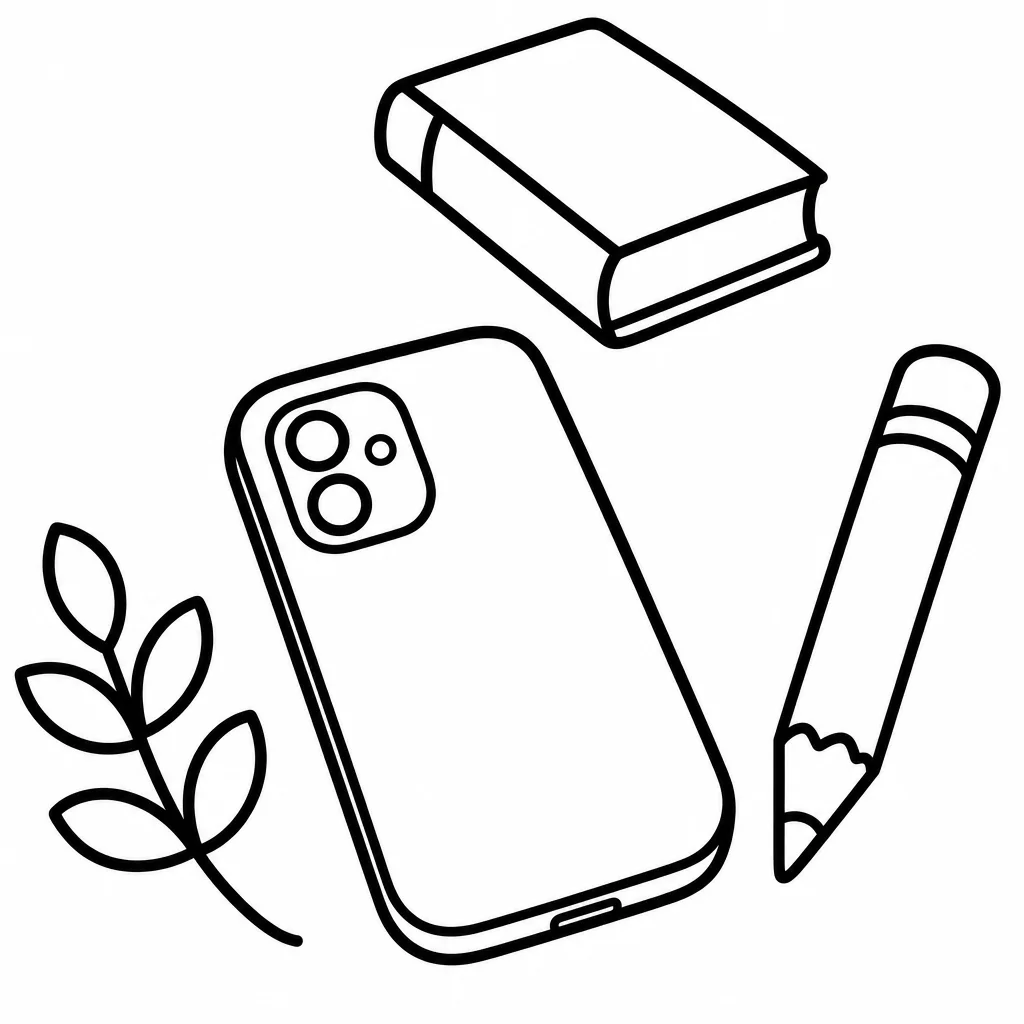
Why a Coloring Page Is the Right Landing Pad
Most evening activities fail for one of three reasons: they need decisions, they need light, or they need to be finished before you can stop. A coloring page avoids all three.
Bold & Easy pages — thick 1.2pt outlines, large shapes, minimal interior detail — are designed for tired eyes and low light. Under one lamp, with no detail to squint at, they ask nothing of you but the next shape. And a single motif is a completable unit: fifteen to twenty-five minutes, one page, an actual end state. After a day made of unfinished things, that ending is the point.
The comparison is easy to feel. Scrolling is infinite, frictionless, and loud. A page is finite, tactile, and quiet. Evenings in the darker half of the year need the second kind of activity, because the first kind is available in unlimited supply and will happily take the whole night.
Two practical notes. Use pencils rather than markers for evening sessions — they are silent, they do not smell, and they work in low light without bleeding. And choose your page before the digital sunset, not during it: choosing while tired is a decision, and this ritual is meant to be decision-free.
What to Do With the Reach Reflex
Your hand will reach for the phone anyway — at minute four, at minute eleven, probably again at minute nineteen. Plan for it instead of being surprised by it.
- Keep the phone out of arm's reach. Distance does more work than intention.
- If the phone must stay in the room — kids, caregiving, on-call — close the infinite apps, not the device. Keep calls and messages; remove the feeds. The boundary is about endless input, not about being unreachable.
- Park stray thoughts on paper. Keep a small notepad beside your page. Anything you suddenly "need" to look up goes on the pad, to be looked up tomorrow. Most of it will not survive the night, which is information worth having.
This is a habit swap, not a willpower contest. The page wins by being easier to start, not by being more virtuous.
The Shared Version: A Household Digital Sunset
The ritual scales to a household without a lecture. Put a basket by the door or a drawer in the kitchen, and let the lamps come on while the screens go in. Leave paper and pencils on the table where the tablet usually lives. Children copy what is visible far more readily than what is announced — and an hour where the adults are also coloring is a much easier sell than an hour where everyone else is bored.
Frequently Asked Questions
Q: What time should a digital sunset be?
A: Anchor it to sunset — screens down within an hour of it — rather than to a fixed clock time. Your boundary then moves naturally through the season: around eight in mid-September, closer to six by late October. In far-northern winters, anchor instead to dinner or the first lamp.
Q: How is this different from just "no screens after nine"?
A: A clock rule is abstract and easy to renegotiate. A sunset rule is visible from your window, and it arrives with the season's permission. More importantly, a digital sunset includes a replacement: a page, a pencil, a warm drink, and twenty minutes with a shape. The replacement is what makes the boundary stick.
Q: I need my phone in the evening — family, work, on-call.
A: Then the digital sunset applies to the scroll, not the device. Keep calls and messages on, close the infinite apps, and put the phone across the room instead of in your hand. You are ending endless input, not your availability.
Q: What should I color at night?
A: Bold & Easy pages with large shapes and thick outlines, chosen before the session begins. Cozy subjects work especially well after dark — a mug, a lamp, a stack of books, a window, a cat. Pick three to five warm colors rather than the whole tin, and if you want the quietest possible hour, choose a grayscale page and work in shadow.
Q: How long should the session be?
A: One motif, or about twenty minutes — whichever comes first. The point is not progress on the page; it is that the hour has a shape and an end. A half-finished mug at ten past eight still counts.
A Final Thought: Letting the Day End Twice
The sun sets once without asking you. The screens going down is the second sunset, and it is the one you choose. Between them sits the quietest part of the day — a lamp, a page, a warm mug, and hands that finally have nothing urgent to do.
The evenings are getting longer for the next three months. That can be a problem to fill, or it can be the best hour you own.
If you want the audio half of the ritual, Midnight Lo (ASMR Soundscape) is built for exactly this hour — soft rain and low-fi warmth under a single lamp — while Fireside Reverie (ASMR Soundscape) trades the rain for a crackling hearth. For the version of this ritual that ends at bedtime, One Page Before Bed is its natural sequel.