

There is one evening every autumn when the clock stops meaning what it usually means. You set it back an hour before bed, and in the morning you wake up with an hour that did not exist the day before — a small, paper gift from the calendar. Then, somewhere around four o'clock, you notice the other side of the trade: the sun is already thinking about going down.
A clock change evening ritual is a way to hold both sides of that trade at once. You do not spend the gift hour scrolling, or folding it into chores until it disappears. You spend it deliberately — lamp on early, one warm drink, one coloring page — while your body quietly works out the difference between the clock on the wall and the clock inside you.
Why the Clock Change Feels Off
The clock changed, but your body did not. It runs on a roughly twenty-four-hour internal rhythm that is set by light and darkness, not by the little hands. When the wall clock jumps and the sun keeps its own schedule, the two stop agreeing, and for a few days everything feels a degree out of true — tired at the wrong time, hungry at the wrong time, awake at the wrong time. It is a jet-lag feeling with no airport at either end: nothing about your day has actually changed except the number on the clock, and yet the evening arrives an hour sooner while your body keeps checking its own watch against the darkening window.
The mismatch is real, and it is smaller than it feels. Even a one-hour change can throw off sleep schedules, health reporters note, because while the clocks move, work and school start times stay exactly where they were. ( Here's what happens to your body when clocks 'fall back' an hour — WISN / AP) Your body is not broken; it is just a day or two behind the calendar, the way you feel slightly displaced after a long flight.
The ritual does not try to fix that gap with force. It simply makes the shifted evening pleasant to sit in while the gap closes on its own.
The Ritual in Three Moves
The whole thing takes about as long as the hour it celebrates, and none of it requires anything you do not already own. You can do it alone or with the whole household, in a kitchen or a living room or the corner of a bedroom. The only requirement is that the evening is allowed to be slow.
- Light the lamp before the dark arrives. Do not wait until the room feels dim and then react. Turn on the lamp, the string lights, or the candle while there is still a little daylight left, so the shift from day to evening is a choice you made rather than something the season did to you.
- Decide what the extra hour is for. Before the evening starts, name the gift hour out loud or on paper: coloring, a bath, a long unhurried dinner, a chapter of the book. A gift with no recipient gets swallowed by the first thing that asks for it, so give the hour a destination before it begins.
- Color one page while your body catches up. One motif, a handful of pencils, no decisions. The page is not the point; it is the place your hands go while your internal clock and the wall clock negotiate their differences in the background.
That is the entire ritual: light early, name the hour, and give your hands something quiet to do. The body does the rest.
What to Color on a Clock Change Evening
Choose pages that match the hour you are in — the early dark, the lamplight, the feeling of time made gentle.
- Lamps and lamplight. The single most fitting subject: the warm circle of a shade, a floor lamp, a candle. You are coloring the very thing holding the dark at bay.
- Windows at dusk. A pane with the last of the day outside it. The earlier sunset, drawn in simple lines and then softened with color.
- Clocks and mantel pieces. A face with hands, an hourglass, a wall clock made harmless on paper. Time, for once, sitting still.
- Mugs and steam. The warm anchor in your other hand. A cup, a curl of steam, a saucer.
If you want pages built for exactly this kind of evening, After-Work (Printable PDF) ($6.99) is full of calm, simple, end-of-day scenes — and every book ships with a QR-linked soundscape called Evening Glow & Soft Blankets, a soft acoustic piece made to sit under a single lamp.
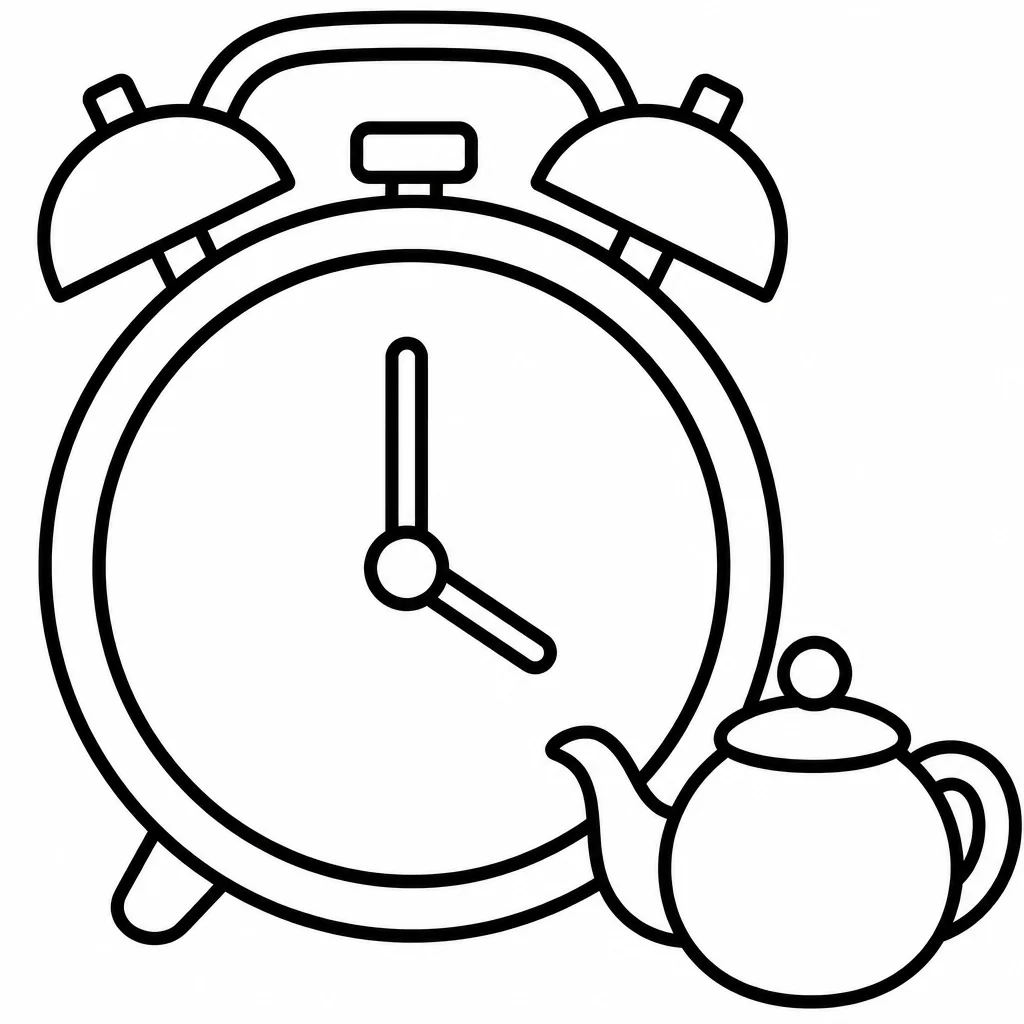
The Clock Change Palette
The shifted evening wants two families of color: the dusk outside and the warm inside. Start with the blues — a deep dusk blue, a grey-violet, one pale slate for the window glass. Then put every warm color inside the frame: amber, honey, brick, and a soft cream for the lamplight.
The contrast does the work. A page that holds the cold blue of the early dark against the warm gold of a lamp is the whole ritual in miniature: outside is earlier than it used to be, and in here the light has already been lit. Three to five pencils is plenty — a small palette is a small decision, and the evening should not ask you to make big ones.
A Few Days of Grace
Give the adjustment a little room. The same health guidance that describes the disruption offers a gentle fix: morning light is what resets the rhythm, and shifting a bedtime by as little as fifteen minutes at a time helps the body ease across the change rather than jump it. ( Here's what happens to your body when clocks 'fall back' an hour — WISN / AP)
So the ritual is not a single night. It is a few evenings in a row — lamp on early, the extra hour spent on purpose, one page, and a little morning light through the window when you can. By the middle of the week the disorientation mostly passes, and what remains is a habit worth keeping: an evening that belongs to you, lit and settled, with no need for the excuse of a clock change to justify it. That is the quiet reward of the whole thing. The first night you do it for the clock; by the fourth night you are doing it for yourself, and the clock is just the excuse that got you started.
Frequently Asked Questions
Is this different from the screen-free evening or the sweater weather ritual?
Only in its anchor. The screen-free evening runs on putting the phone down, the sweater weather ritual runs on warmth, and this one runs on time — the small gap between the wall clock and the body clock, and the gift hour that comes with it. They are siblings. If you want the version built around putting screens away, the digital sunset is its natural companion.
Do I have to do it on the exact night the clocks change?
No. The disorientation lingers for a few days, and the ritual works on any of them. The first evening is the most obvious, but the second and third are where it earns its keep.
What if I do not feel the hour at all?
Then skip the disorientation and keep the hour. Not everyone notices a one-hour shift, and that is a gift too — an extra evening hour with no tax. The lamp and the page still work; they just work without the explanation.
How long should I color?
Until the page stops feeling like a gift — usually fifteen to twenty-five minutes. There is no minimum and no streak to protect. The point is that the hour had a shape, not that you filled it.
Is it better to just adjust my sleep schedule instead?
The two are not rivals. Shifting bedtime gradually and getting morning light are the practical fixes; the evening ritual is what makes the shifted evening pleasant to live in while those fixes take effect. You can do both.
A Final Thought: The Hour That Was Never Owed
Most of the year, the clock only ever takes. It takes minutes in the morning, an hour at the end of a long day, the last light of the afternoon. Once a year, in autumn, it gives one back — and most of us hand it straight to the inbox, the laundry, or the endless feed.
A clock change evening ritual is a small refusal. You take the hour the season handed back, you light the room before the dark arrives, and you spend the gift on the person the year keeps forgetting to pay. The wall clock and the body clock will find their way back to agreement soon enough. In the meantime, there is a lamp, a page, and an hour that is finally, completely yours.