

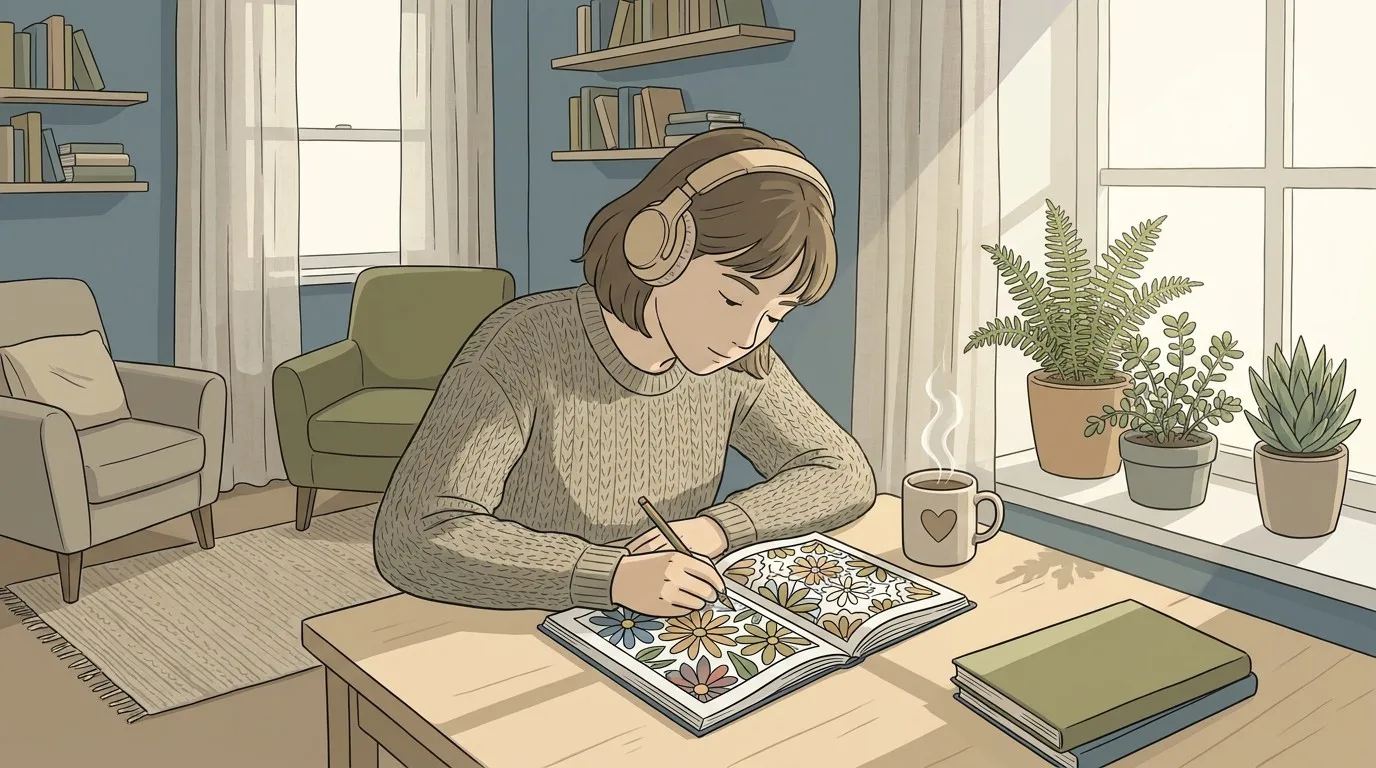
If you have ADHD, your brain is constantly on a hunt. It is searching for that next spark, that next pocket of interest, and most importantly, that next drop of dopamine. The standard advice of "just sit still and meditate" or "read a book to calm down" often feels like asking a race car to idle at a red light with its engine revving. It does not work, and it usually leads to more frustration.
But what if the key to calming a hyperactive mind was not sitting in empty silence, but engaging in a low-friction, deeply satisfying sensory loop?
Enter dopamine coloring. In recent years, thousands of adults with Attention Deficit Hyperactivity Disorder (ADHD) have turned to coloring as a powerful, non-pharmacological tool to soothe anxiety, quiet mental chatter, and achieve a state of relaxed focus.
But does coloring help with adhd from a scientific standpoint, or is it just a passing trend? In this article, we delve deep into the neuroscience of the ADHD brain, the mechanics of dopamine coloring, and how you can use this simple ritual to find your daily pocket of peace.
---
1. The ADHD Brain and the "Dopamine Deficit"
To understand why coloring is so effective, we first need to look at how the ADHD brain operates.
At its core, ADHD is not a lack of attention; it is a regulation of attention issue. The brain's executive functions are regulated by neurotransmitters, primarily dopamine and norepinephrine. In an ADHD brain, there is a lower baseline of dopamine. This deficit creates a constant state of under-arousal.
To cope, the ADHD brain seeks stimulation (micro-dopamine hits) from its environment. This is why you might find yourself constantly switching browser tabs, scrolling social media, or feeling an overwhelming urge to fidget.
When you engage in an activity that provides a steady, predictable, yet creative sensory stimulation—like moving a colored pencil across a thick, textured line—you satisfy the brain's craving for micro-stimuli. By giving the "seeking" part of your brain a simple, structured task, the rest of your cognitive mind is finally freed to relax.
---
2. What is Dopamine Coloring?
Not all coloring pages are created equal, especially for those with ADHD.
Many adult coloring books on the market feature incredibly intricate, tightly wound mandalas or tiny, microscopic geometric patterns. While these "micro-detail" books appeal to some, they can often trigger overwhelm or perfectionism paralysis in an ADHD mind. If you feel like one wrong stroke of a pen will ruin the entire page, the activity ceases to be relaxing.
Dopamine coloring is different. It relies on "Bold & Easy" designs—large, organic shapes, thick lines, and whimsical scenes (like cozy rooms, forest animals, or botanical gardens).
These designs are intentionally crafted to be:
- Low-Friction: You can finish a section in 5 to 10 minutes, providing an immediate sense of completion (a micro-dopamine hit!).
- High-Satisfaction: Large fields of color allow you to focus on the smooth glide of the marker or pencil rather than worrying about crossing the lines.
- Sensory-Rich: Combining coloring with complementary sensory signals—like listening to custom ambient soundscapes or ASMR rain—creates an immersive sensory bubble that blocks out external anxiety triggers.
---
3. How Coloring Acts as an "Active Meditation"
Traditional meditation requires you to empty your mind. For someone with ADHD, this is often an agonizing invitation for hyperactive thoughts to spiral.
Coloring acts as a form of active meditation or "focused distraction." It occupies your hands and visual field with an uncomplicated, low-stakes task. This engages what psychologists call the "default mode network" (DMN) of the brain in a gentle, non-threatening way.
As you focus on selecting colors and shading a shape:
1. Your Heart Rate Slows: The repetitive, rhythmic motion of coloring triggers the parasympathetic nervous system, lowering your physical stress response.
2. Hyper-Focus is Channeled: The ADHD tendency to hyper-focus is safely channeled into a harmless, non-work-related outlet, protecting you from cognitive burnout.
3. The "Internal Critic" Quiets: Because there is no "wrong" way to color a whimsical mushroom or a cozy cafe nook, there is no performance pressure. You are creating for the pure joy of the process.
---
4. The Power of Sound-Enhanced Coloring
At Cozycolor Sanctuary, we believe that visual calm is only half of the equation. To truly quiet an ADHD mind, you need to engage multiple senses.
This is why we pioneered Sound Edition Coloring. Every digital coloring book in our collection features a custom-engineered ASMR ambient soundscape. By scanning the QR code included in your coloring book, you unlock a high-fidelity sound bubble—ranging from *'Echoes of the Moonlit Woods'* to *'Soothing Forest ASMR'*.
This combination of tactile action (coloring) and auditory masking (ASMR and ambient white noise) creates the ultimate shield against mental overload. The sound blocks out sudden distracting household noises, while the coloring blocks out internal anxious loops.
---
5. How to Create a Calming Daily Coloring Ritual
If you want to use coloring as a genuine tool for ADHD and anxiety management, consistency beats intensity. You do not need to color for hours; just 10 minutes a day can reset your nervous system.
Here is a simple blueprint to establish your daily pocket of peace:
1. Pair It with a Pleasant Anchor: Make coloring part of your morning coffee routine or your post-work transition. Swap the dopamine-draining morning scroll on your phone for 10 minutes of paper coloring with your coffee.
2. Minimize the Friction: Keep your coloring sheets and favorite pens in a beautiful basket on your table, ready to go. If you have to dig through drawers to find your supplies, your brain will choose scrolling instead.
3. Choose Printable PDFs for Infinite Repeats: Traditional books can feel permanent. With printable PDFs, you can print your favorite "Bold & Easy" pages on high-quality, thick paper as many times as you like. Want to try a completely different color palette? Just print a fresh page.
4. Activate the Soundscape: Put on your headphones, scan your Cozycolor soundscape QR code, and let the ASMR sounds wash over you as you lay down your first stroke of color.
---
Frequently Asked Questions
Q: Does coloring help with ADHD focus and concentration?
A: Yes. Many individuals with ADHD find that engaging in a simple tactile activity like coloring helps keep the under-aroused part of their brain occupied, actually making it easier to listen to audiobooks, participate in phone calls, or process thoughts without their mind wandering.
Q: Why do some adult coloring books make my ADHD anxiety worse?
A: Highly complex, dense geometric patterns require extreme visual precision, which can trigger perfectionism, eye strain, and cognitive fatigue. ADHD brains usually respond much better to "Bold & Easy" style coloring books, which have thicker lines, larger spaces, and whimsical, calming themes.
Q: What is the best paper for printing digital coloring pages?
A: We highly recommend printing your PDFs on cardstock or thick mixed-media paper (typically 120gsm/80lb or higher). This ensures that your markers, gel pens, or watercolors will not bleed through, preserving the tactile satisfaction of your coloring experience.
---
Conclusion: Claim Your Pocket of Peace
If you are looking for a gentle, science-backed way to quiet the noise in your head, coloring is a proven, beautiful place to start. It respects the way your brain is wired, offering stimulation without overwhelm and relaxation without boredom.
Ready to start your own dopamine coloring journey? Discover our signature collection of "Bold & Easy" digital coloring books—each complete with custom ASMR ambient soundscapes.
👉 Explore the Cozycolor Shop All Sanctuary Collection and Download Your Calm Today!
---