

The Sensory-Safe Home: The Ultimate Guide to Designing a Cozy Home Sanctuary for ADHD
For the neurodivergent mind, the home is rarely just a house. It is either a source of constant overstimulation or a vital refuge from a world that feels too loud, too bright, and too fast. When your brain is wired with "47 open tabs," the physical environment around you acts as either a noisy background track or a steadying anchor.
Designing a cozy home sanctuary for ADHD isn't about interior design trends; it's about nervous system regulation. It's about creating a "visual quiet" that allows your executive functions to rest. At CozyColor Sanctuary, we believe that art therapy and environmental design are two sides of the same coin. In this comprehensive guide, we’ll explore the science of sensory-safe spaces and show you how to build your own 15-minute reset corner.
The Science of ADHD Overstimulation: Why Your Environment Matters
The ADHD brain often struggles with "sensory gating"—the ability to filter out irrelevant stimuli. A pile of laundry, a flickering fluorescent light, or a cluttered shelf isn't just a mess; it's a series of micro-interruptions that drain your cognitive battery.
When you engage in Designing a cozy home sanctuary for ADHD, you are effectively performing "environmental medicine." By reducing visual noise and prioritizing soft textures, you lower the baseline cortisol levels in your body, making it easier to transition from the "doing" mode of the workday to the "being" mode of restorative rest.
## Core Pillars of an ADHD-Friendly Sanctuary
1. Visual Decompression: The Power of "Visual Quiet"
Cluttercore might be an aesthetic trend, but for many with ADHD, it can trigger a "task-switching" loop where every object demands attention.
- Hidden Storage: Use opaque bins rather than clear ones. If your brain can't see the "to-do" items inside, it doesn't have to process them.
- Low-Contrast Palettes: Choose a color story rooted in nature—sage greens, warm woods, and soft oatmeals. These colors have shorter wavelengths, which are physically less taxing for the eye to process.
### 2. Auditory Anchoring with Cozycolor Ambient
A sanctuary should have its own "sound signature." Total silence can sometimes feel under-stimulating for ADHD, leading to internal racing thoughts.
- Consistent Backgrounds: Use white noise or, better yet, Cozycolor Ambient soundscapes like *'Fireside Reverie'* or *'Rainy Greenhouse'*. These rhythmic, predictable sounds act as a "focus bubble," masking unpredictable external noises like traffic or neighbors.
### 3. Tactile Grounding: The 15-Minute Reset Corner
Every home sanctuary needs a dedicated "Grounding Station." This is a small, low-stim area (even just a specific armchair) reserved exclusively for screen-free rituals.
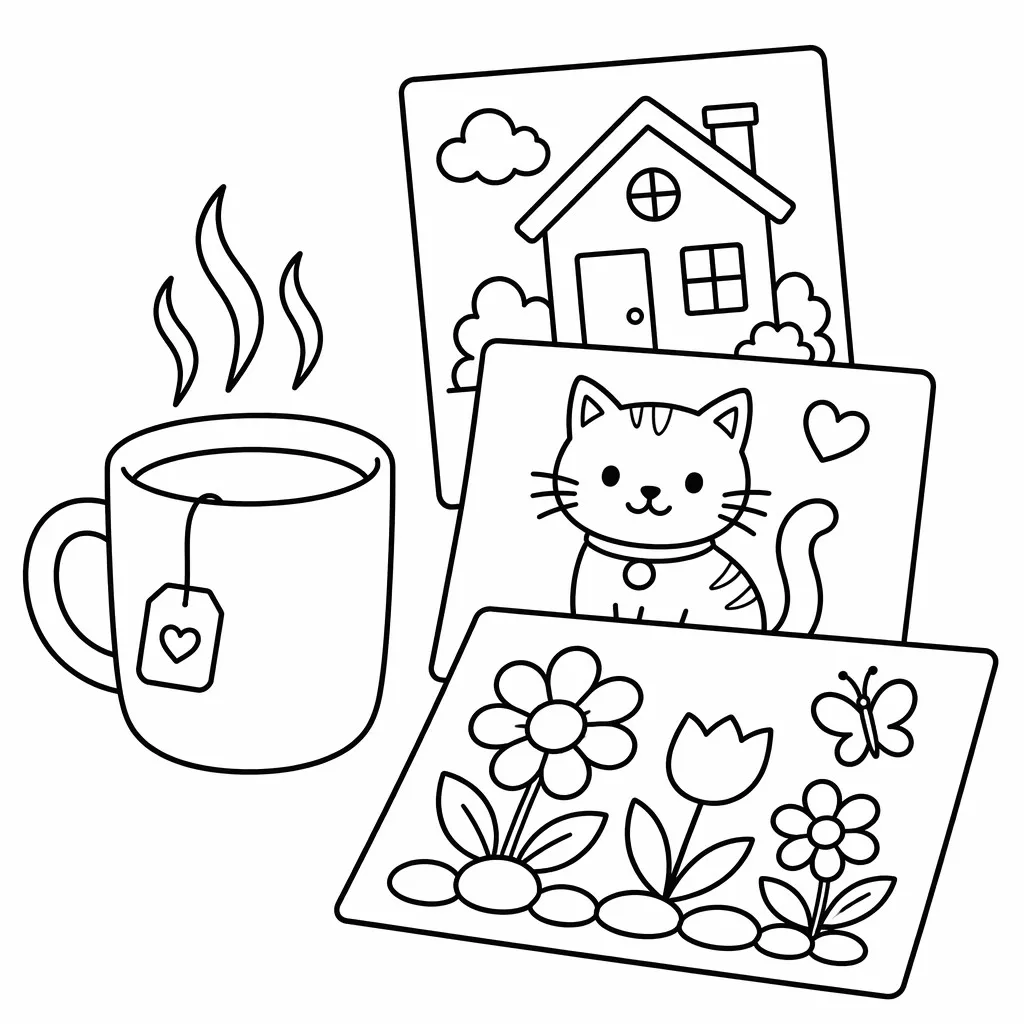
- The "Bold & Easy" Anchor: Keep a physical, high-resolution printable coloring book and a set of markers in this spot.
- Why Bold Lines Work: Traditional adult coloring books are often too complex, triggering "perfectionism paralysis." Our signature Bold & Easy 1.2pt outlines provide the visual boundaries your brain needs to feel safe and successful immediately.
## Step-by-Step: Building Your Home Sanctuary Ritual
You don't need a renovation to see results. Follow this simple 3-step transition ritual:
### Step 1: Lighting the "Safe Mode" Signal
As soon as you finish work, dim the overhead blue lights. Switch on a warm lamp or a salt lamp. This physiological cue tells your amygdala: *“The external demands of the world have ceased.”*
### Step 2: The "Digital Fast" Transition
Put your smartphone in a "charging box" in another room. For 15 minutes, engage in an analog activity. The weight of markers on heavy paper and the tactile rhythm of coloring provide a grounding effect that a screen-based app cannot replicate.
### Step 3: Layering the Senses
Put on your noise-canceling headphones with a Cozycolor Ambient track. Open your coloring page. Don't look for the "perfect" design—pick the first one and follow the bold black lines. This multi-sensory feedback loop (visual + auditory + tactile) is the fastest way to "reset" an ADHD brain.
## Frequently Asked Questions
### Q: Is a home sanctuary the same as a "sensory room"?
A: While they share goals, a sanctuary is more about integrating calm into your daily life. It’s less about a high-tech "padded room" and more about curating textures, lighting, and rituals that support your specific neurotype.
### Q: What if I live in a small apartment?
A: A sanctuary isn't a square footage requirement; it’s a sensory boundary. A "sanctuary" can be as small as a dedicated tray containing your coloring supplies and a specific pair of noise-canceling headphones.
### Q: Why do you recommend analog coloring over digital?
A: Analog coloring removes the blue light that interferes with melatonin production. Additionally, the physical resistance of the marker on paper provides "proprioceptive input," which is highly grounding for the neurodivergent nervous system.
## Conclusion: Build Your Peace, One Bold Line at a Time
Your home should be the place where you finally stop performing. By designing a cozy home sanctuary for ADHD, you are giving yourself permission to slow down. You are building a manual "power button" for your racing mind.
Stop performing. Start playing. Your sanctuary is waiting.