

We have all been there. It is 11:00 PM. You have turned off the lights, put away your laptop, and crawled into bed. But as soon as your head hits the pillow, the "mental static" begins. Your brain starts reviewing your mistakes from three years ago, worrying about next week's deadlines, or looping through hypothetical arguments.
For millions of adults, nighttime is not a time of rest, but a time of peak anxiety. While standard advice usually includes "counting sheep" or "white noise," these passive solutions often fail because they don't give a hyperactive mind anything to *do*.
Enter the world of therapeutic coloring. In this article, we delve into why coloring for anxiety relief is becoming the preferred nighttime reset for high-stress professionals and overthinkers, and how you can use it to claim your own daily sanctuary.
---
1. The Neuroscience of "Amygdala Calming"
When you experience anxiety, your amygdala—the brain's emotional "smoke detector"—is in an overactive state. It is constantly scanning for threats, even when you are safe in your home.
Engaging in a rhythmic, creative task like coloring acts as a physical "off switch" for this survival response. As you focus on the movement of a pencil or marker across the paper, you are performing a task that requires just enough cognitive effort to distract you from anxious thoughts, but not enough to cause stress.
Psychologists call this "low-stakes focus." By replacing internal abstract worries with a concrete, colorful task, you effectively de-escalate your nervous system from a "Fight or Flight" state into a "Rest and Digest" state.
---
2. Why Intricate Patterns Often Fail for Anxiety
A common mistake many beginners make is choosing "micro-detail" coloring books—those filled with thousands of tiny, microscopic geometric shapes. While these may look beautiful, they can often be counterproductive for someone already suffering from anxiety or ADHD.
If a coloring page feels like a "test" of your motor skills or your patience, it will trigger perfectionism. If you're worried about "staying in the lines" of a tiny pattern, your cortisol levels will actually rise.
At Cozycolor Sanctuary, we advocate for "Bold & Easy" aesthetics. These designs use:
- Thick, defined lines: Creating a safe "boundary" that is easy to follow.
- Large, open fields: Allowing for smooth, broad strokes of color that feel physically satisfying.
- Healing Themes: Whimsical scenes of nature, cozy interiors, and mystical creatures that evoke feelings of safety rather than complexity.
---
3. Creating the "Fireside Reverie" Experience
To truly maximize coloring for anxiety relief, you need to engage more than just your eyes. This is the philosophy behind our Sound Edition collections.
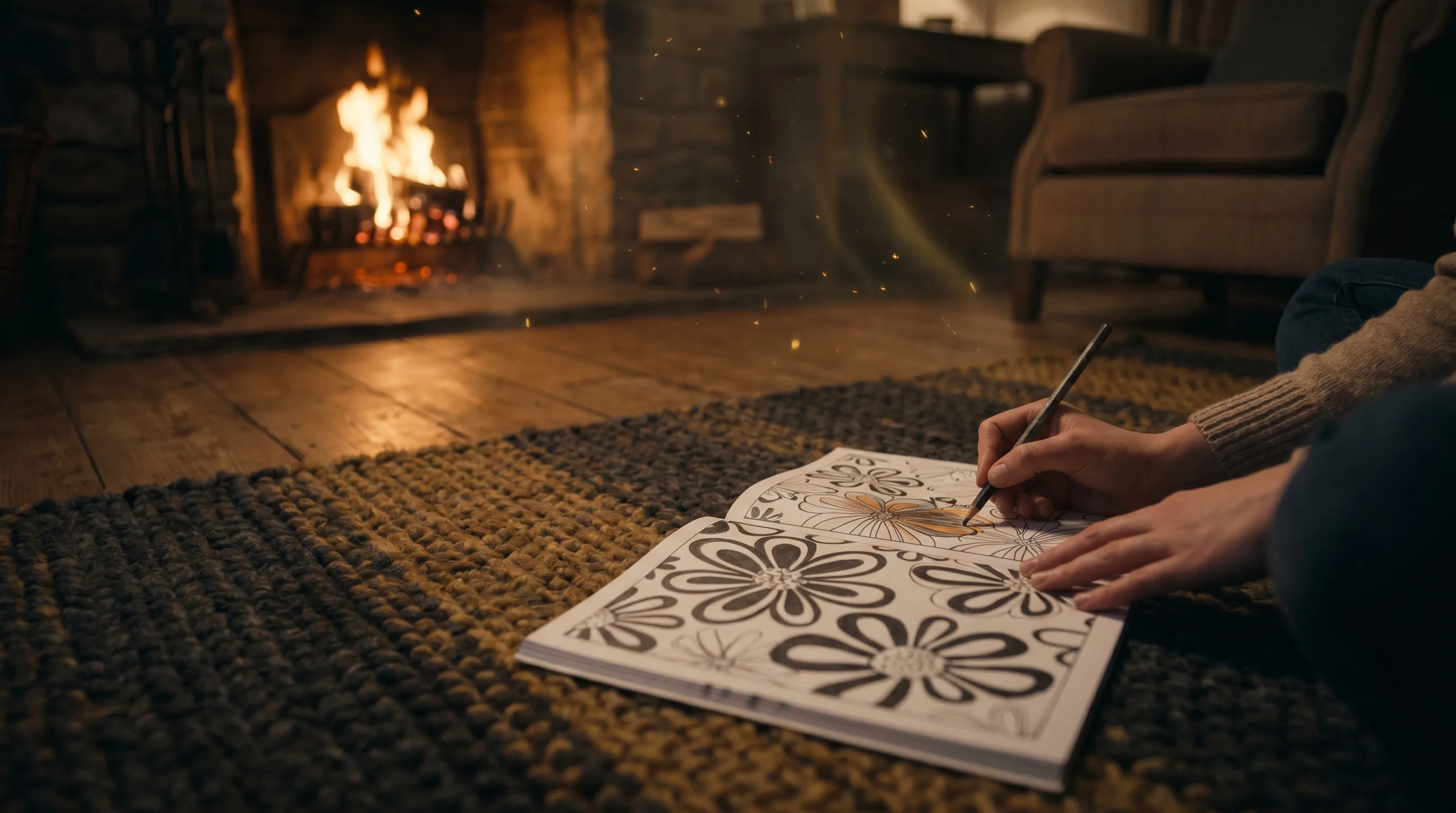
Imagine this: You are sitting in a comfortable chair. The room is dim, lit only by a warm lamp or a fireplace. You have a "Bold & Easy" page from our *Fireside Reverie* collection in front of you.
As you start to color:
1. Scan the QR code: Instantly activate a custom-engineered ASMR soundscape.
2. The Multi-Sensory Bubble: You hear the deep, rhythmic crackle of a stone fireplace and the distant sound of wind through the trees.
3. Sensory Grounding: The combination of the tactile pencil movement and the immersive audio creates a "sensory bubble" that blocks out the noise of the outside world—and the noise in your head.
---
4. Your 15-Minute "Nighttime Reset" Blueprint
If you want to use coloring as a genuine tool for sleep and anxiety management, try this 15-minute ritual before bed:
- Step 1: The Digital Disconnect: Put your phone in another room. The blue light and the constant pings are the fuel for your anxiety.
- Step 2: Set the Scene: Light a candle or use a warm, amber light. Grab a single Cozycolor printable PDF page—print only what you need so you don't feel overwhelmed by an entire book.
- Step 3: The 10/5 Rule: Color for 10 minutes with your ASMR soundscape active. Then, spend the last 5 minutes simply looking at what you created, practicing deep breathing, and letting the finality of the page signal the end of your day.
---
FAQ: Frequently Asked Questions
Q: Can coloring really help with severe anxiety or panic attacks?
A: While it is not a replacement for professional medical treatment, many therapists recommend coloring as a "grounding technique." It forces the brain to focus on the "here and now" (colors, textures, movements), which is a key component in stopping an anxiety spiral.
Q: What are the best colors to use for relaxation?
A: We recommend a "Cool & Calming" palette. Focus on soft blues, sage greens, and gentle lavenders. These colors are psychologically associated with lower heart rates and tranquility.
Q: Is digital coloring as effective as paper coloring for anxiety?
A: For anxiety relief, we highly recommend physical paper coloring. The tactile friction of the pencil on paper and the absence of a glowing screen provide a much deeper "brain reset" than coloring on a tablet.
---
Conclusion: Claim Your Daily Sanctuary
You don't have to live in a constant state of mental noise. By dedicating just 15 minutes a night to a morning coffee coloring ritual or a nighttime reset, you are choosing to prioritize your mental well-being.
Discover our Bold & Easy collections—each designed to be a portal to peace, complete with custom ASMR soundscapes.
👉 Shop the Cozy Sanctuary Collection and Download Your Peace of Mind Today!
---